

By Julienne du Toit
Photographs by Chris Marais
Every early explorer to South Africa seemed to have something to say about the black wildebeest.
William Cornwallis Harris’s description remains a classic: “A more whimsical compound than the Gnoo could scarcely have been thrown together, or a monster imagined of more fantastical and anomalous exterior.”
Hinrich Lichtenstein described it as having the mane and tail of a horse, the head and horns of an ox, and the legs and body of an antelope.
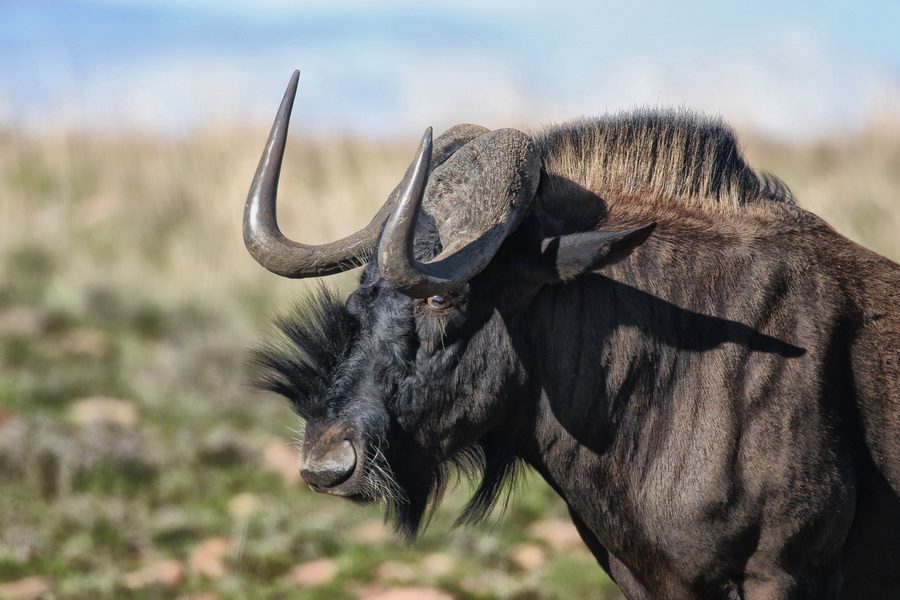
Other writers doted on their strange clown-like antics, their meathook-shaped horns, their heavy shoulders and delicate hindquarters, the stiff hair on their muzzles and manes, and their elegant fly-whisk tail.
Early naturalists had no idea how to classify this strange animal.
An Alluring Hiccup
Black wildebeest used to occur in vast herds and are known for suddenly galloping back and forth across the veld for no apparent reason, then indulging in what can only be called a form of gnu breakdancing.
Territorial black wildebeest males need unobstructed views of their terrain before they will breed. They stay far apart and fiercely defend their turf.

They can be aggressive and their horns are deadly. But when it comes to deciding matters between rival males, these gnus prefer to first indulge in rituals and pageantry.
Their repertoire includes dropping down to roll on their backs, getting up to make exaggerated nodding motions, jumping around on stiff legs, lashing their tails so hard that they make an audible swish, and bawling out their typical cry: ‘ger-nu’.
The winner advertises his status to passing females with an alluring hiccup, a call that can be heard over a kilometre away.
If a female shows any interest, she can expect the next come-hither trick in the black wildebeest love arsenal: a tail flicked over her face.
Millions to Hundreds to Thousands
Europe developed a liking for its hide. Between the mid-1800s to the end of that century, black wildebeest numbers plummeted from millions to a scant few hundred.
A single farm in Kroonstad exported 157 000 black wildebeest and blesbok skins in 1866 alone. The slaughter was staggering.

In the end, it was two farming clans that rescued the species.
By 1890, a certain Free State farmer near Kroonstad called Piet Terblans heard shots, and on investigation, found 27 dead black wildebeest, left to rot. Only one had been skinned. Wildlife writer Don Boroughs records this as the moment Terblans decided to turn the tide.
Without fanfare, the farmer quietly turned his property into a black wildebeest sanctuary. When he died two decades later and hunting resumed on his property, most of the animals fled and took shelter on neighbour Hendrik Delport’s spread.
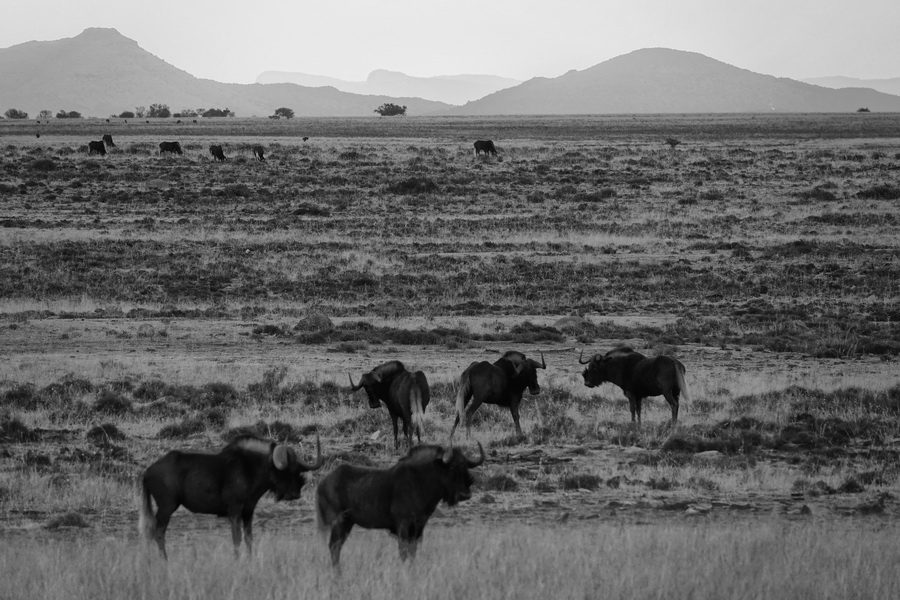
It was the herds from Delport’s farm that were later translocated to other nature reserves by Free State conservation officials and SA National Parks.
They thrive across the dry midriff of South Africa, the Karoo, the grasslands and savannahs, with populations in Swaziland, Lesotho and Namibia too.
The SA National Botanical Institute estimates numbers to have risen over 18 000.
Once Vulnerable, it is now classified as being of Least Concern on the Red List.


