
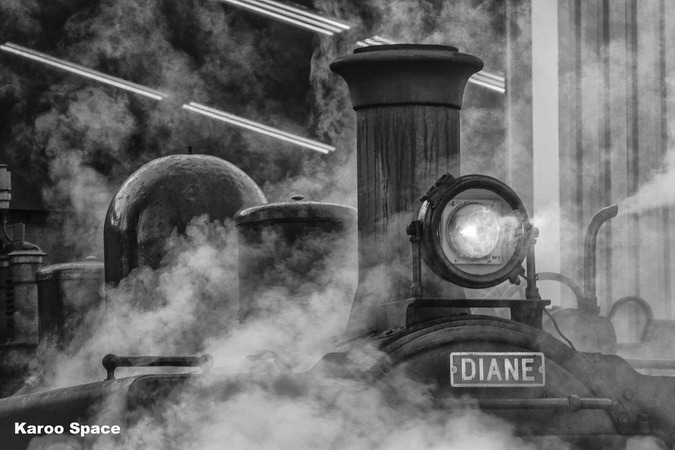
Story and Pix By Chris Marais
De Aar, Springtime, 1988:
In days gone by, when De Aar was a full-steam-ahead kind of town, the locomotive drivers would yank their whistles late at night as they approached the Karoo settlement. Each driver would have his own signature tune, and his family living in the town would know it well. They would prepare for his return the minute that whistle went off.
To the general public of De Aar, the particular lilt of a loco whistle would indicate the way the Karoo wind was blowing that night – and what kind of weather they could expect the next day.
Nearly everything in De Aar revolved around The Colossus, the steam locomotive. For more than a century, the railroad tracks sang the praises of these huge metal dragons criss-crossing South Africa – and meeting in this Northern Cape town.
Steam has disappeared from our railroad system, except for the occasional heritage train experience. And then the sight of a loco in full toot across the veld is a wonderful hit of nostalgia.
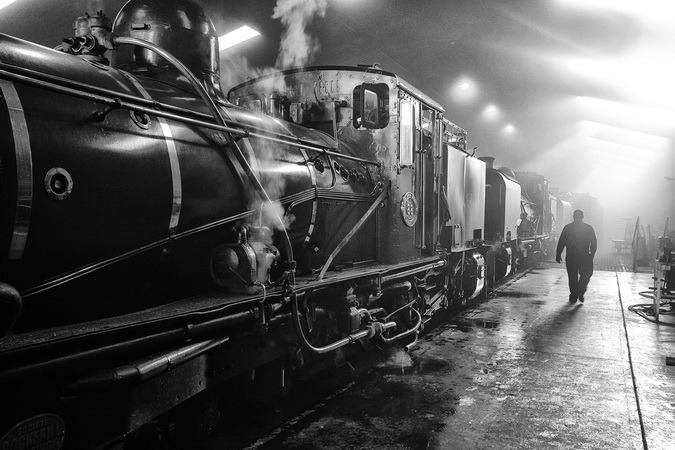
The Steam Town
A long-standing community of locomotive drivers and stokers retired to De Aar in the 1980s, perhaps to be close to one of the country’s last refuges of the steam train. That’s when I caught up with a few of them, and heard their stories.
A man like Piet Claassen grew up next to the tracks, in a little railway house in Kranskuil. His father worked on the railways, and so young Piet joined the SAR&H as well. That was the way, then.
“If your father was a railroad man, you became one as well,” said this huge 49-year-old senior staffer at De Aar Station.
When Piet was 16, he went to Keetmanshoop in the then-South West Africa as a station cleaner. It was the only job available on the railways, and he spent six long months cleaning trains and learning the time-honoured art of stoking.
One day a stoker fell sick and the supervisors chose someone from the yard – Piet Claassen. The driver was one Willem Rossouw, with 30 hard years’ experience.
“Willem was a good man. He knew his train well. If you couldn’t keep the steam flowing, he did it for you.”
100 Things to Learn
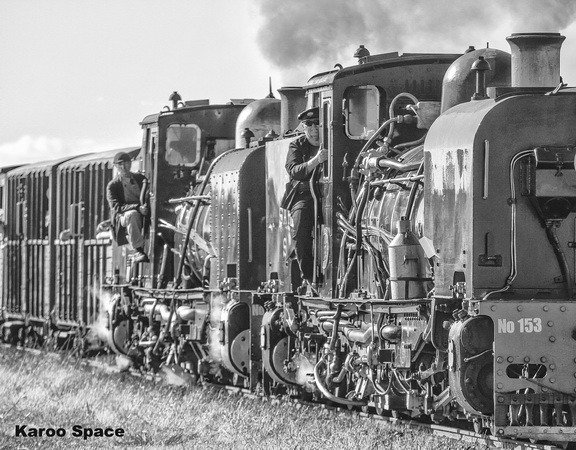
Piet Claassen became Willem Rossouw’s regular stoker, the “driver’s eyes on the left hand side”.
He would fire up the loco and he would keep that fire burning for 21 days. Then the steel, brass and copper machine would have to be meticulously serviced, cleaned and polished.
There were a hundred things to learn: water levels to be kept constant, steam pressure to be monitored, the fire kept “just right”, the sound levels sweet and on an even keel.
“The sound in a steam locomotive is very important. And there was always a lot of it. The funny thing was, we used to sit in the caboose and talk through all that hissing and chugging. We somehow heard each other, or read each other’s lips – it was strange.
“If we were sitting somewhere else, with that level of noise going on, there was no way we could hear normal speech. I suppose the old ear just tuned the steam sound out.”
Train Songs
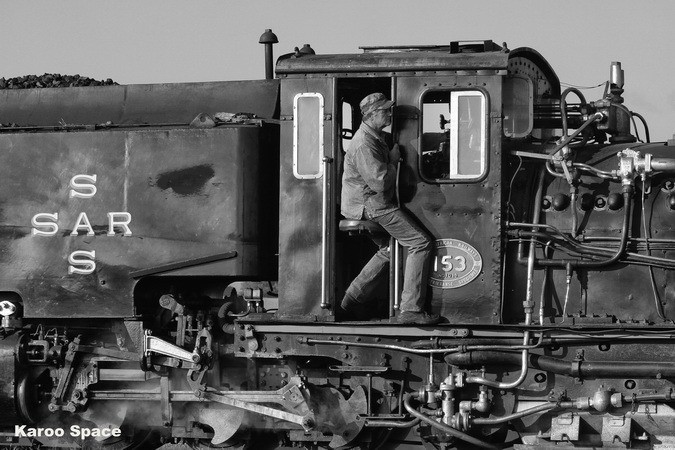
He described the different sounds made by the loco on a run:
“You’re going up a steep hill in 425 tonnes of steam locomotive. That old thing talks to you, you work on the sounds and the cadences. And then on a straight, with speed, there comes that smooth, rhythmic chug – and you’re at one with your train.
“The locomotive sounds are rooted in you. You learn to pick up the smallest abnormality. And the sounds come from everywhere: the stoking, the wheels, the regulator, the valves, the steam release.”
When Piet Claassen finally became a loco driver, he took on two habits which soon became his trademarks: a constantly-lit pipe filled with Boxer tobacco and a dog called Boel. The dog would sit at his feet in the caboose through all his long trips, traversing the Karoo at night, sleeping over in the Kimberley Station rest rooms and keeping him company on his long shifts away from home.
“I smoked a pipe because when you light a cigarette in the cabin, the wind smokes more of it than you do. And the dog, well, one day the loco inspector discovered him up there with me. Boel had to stay home after that.”
He said the crew stop-overs at the rest rooms across South Africa were an essential element of the fun in the job.
Night Whistles
“You prepared your own food in these rest rooms and were supposed to catch some sleep before your train continued. But you actually ended up with some of the other crews, swapping stories through the night.”
Abraham Isaac Ludwick goes by the name of Oom Apie. He is retired and living in De Aar in a house that was once not too far away from the night whistles of the incoming locomotives. Oom Apie Ludwick always wanted to join the army but he was too short, he says.
“It was just after the Depression. I became a coal trimmer with the railways. Then I became really interested: I realised these colossal machines would show me the world one day. I became a stoker at 23, a driver at 30.”
As a stoker, he worked with two drivers, Vlakhaas Davis and Fred Budd. He stoked from Kimberley to Beaufort West, Keetmanshoop to Luderitz and then up on the Johannesburg run.
“In those days, the drivers had no mercy for you. Today, they love you.”

Breakfast on the Shovel
Some folk believe that if the Voortrekker invented the braai, then the train men perfected it.
“We used to take the shovel and load eggs, bacon and sausages onto it. After a short stay in the furnace, the aroma of the best breakfast in the world would filter through the loco. Likewise, coffee brewed in a steam locomotive cannot be beat.”
Oom Apie Ludwick has some taped memories of the Era of Steam, mostly friends of his who had recorded their experiences for posterity. Playing the tape, you hear those old voices bringing back the past.
“…you came to know the spade. Placing the coals carefully onto the furnace, 12 hours a day. You were exhausted, but then that was life. Other stokers would teach you the spade, you would get better with the days.
“Once the steam is in your blood, you cannot keep it out. When a loco beats well, you get chicken bumps on your body. The hissing of the steam, the smell of the oil. That whole machine has a life of its own.”
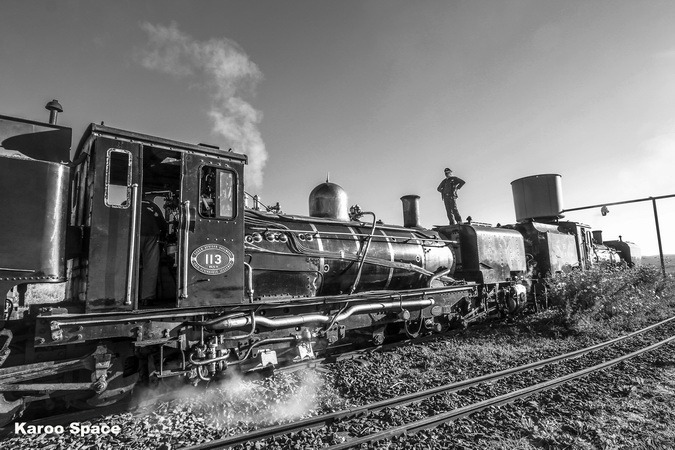
- The accompanying photographs were shot on location at Sandstone Estates outside Ficksburg, Free State, during one of their Stars of Sandstone events. For more info: sandstone-estates.com
- This is an extract from Karoo Roads I – Tales from the South African Heartland by Chris Marais and Julienne du Toit. For book purchases, contact Julienne at julie@karoospace.co.za


