

Story and Pix by Chris Marais
One of the key elements of Lord Kitchener’s master plan to finally bring rebel Afrikaner farmers to heel in the Second Anglo-Boer War was the establishment of nearly 8 000 blockhouse fortifications running right across South Africa and along the major rail routes. These would be manned and the spaces between them patrolled.
The first fortifications consisted mainly of corrugated iron, a wondrous new arrival from Britain that had sheltered many a miner in South Africa since the early 1870s. Eventually made of mild steel with a hot-dip galvanized finish, the sheets of corrugated iron provided very little protection from the powerful Mauser, Mannlicher and Martini-Henry rifle fire of the Boer horsemen. And when it came to harsh Karoo winters and summers, you either froze or sweltered under corrugated iron.

Fancy Fortifications
So the British engineers came out and built more than 400 large blockhouses in a fancy variety of styles. Blockhouses erected in the Magaliesberg ranges, mostly on hilltops, were one-storey high and sported crenellated parapets, as if the designers were setting up mini-castles. The blockhouse at Broederstroom had a fireplace for winter comfort and year-round cooking. The little blockhouse that overlooks Prieska in the Northern Cape was built from the locally abundant Tiger’s Eye stone. Noupoort’s blockhouse looks like an old Dutch mill from the outside.
However, the standard Orange River blockhouses were three storeys high, of dressed stone and low-pitch corrugated iron roofs. Steel firing boxes jutted out from the sides, water was stored on the ground floor which was separated from the first-floor sleeping quarters by a thick steel trapdoor and the top floor was where you kept watch and shot from. Many blockhouse firing loopholes were numbered so that as a British soldier, presumably, you were assigned to a specific position. You were watered and fed by passing trains or, if stationed out in a veld blockhouse, via water carts and supply wagons.
Barbed wire, especially the much-prized eight-strand variety, was spanned between blockhouses right across South Africa.

Life in a Blockhouse
Spare a thought for those who manned the blockhouses, some fresh from an English village, others from a faraway rural kraal, now in the middle of a very dry nowhere, living the typical army dream of ‘hurry up and wait’.
Thomas Packenham, in his seminal work The Boer War, talks of “Tommy Adkins’ (the common nickname for a British soldier) sense of the excruciating boredom of life in the blockhouse.”
“They made the best of blockhouses,” says Packenham. “They planted petunias in bully-beef tins…they wrote letters home, tens of thousands of them, stiff-upper lip letters for the most part, to be collected by the weekly mail wagon. There was little to gossip about on the telephone that connected every blockhouse to its neighbor. But there were pets to be looked after: dogs, goats, pigs, even lizards. And just occasionally, a whirlwind in the night, a summer storm rattling the tin-cans on the trip-wires so that they rang like a xylophone, and, setting off a fusillade of shots into the darkness, there was a visit from a party of guerillas.”

Blockhouse Hill
Back in 2005, I sleep over at Prior Grange Guest Farm just outside Springfontein in the Free State. My co-host Blackie de Swardt, a farmer-historian who loves playing cricket, takes me up a hill early one morning to look at his faithfully-reconstructed blockhouse.
Down below, the highway is churning with freight trucks and the Free State mists are dissipating. The blockhouse would have been home to seven soldiers, who would spend more than three months under this infernal corrugated iron roof looking out for their Boer enemies. Then they would be replaced by another squad of seven men.
I spot a pile of very large, rusty tins on some rocks nearby.
“Those were their rations,” says Blackie. “The tins would contain bully beef, stew and biscuits. Sometimes the food was contaminated and the tins swelled up. You ate that, you got ptomaine poisoning. The Tommies called it Blow Me Down Stew.”
Saluting Dummies
While casting about for more information on what it was like to park under tin in these harsh climes for three months, I discover an excellent document written by researchers Johan Hattingh and Andre Wessels (University of the Free State) called Life in the British Blockhouses During the Anglo-Boer War, 1899-1902.
This gives me more of an insight, and suddenly those few hulking, often broken-down buildings I keep finding in the Karoo come alive with the ghosts of soldiers, both black and white. A lot of ghosts, as it turns out: more than 85 000 individuals manned the British blockhouse system and yet they still had to fool the Boers that the numbers were higher.

“Crews sometimes placed dummies which looked just like guards outside the blockhouses to dissuade the Boers from attacking them,” they say. “Such a dummy was generally dressed in khaki and had a medal or two fixed to its left chest. The medals were manufactured of tin. An imitation rifle was generally placed in his hands and, to round off the picture, a whiskey bottle was stuck into his pocket.
“As the war continued, the dummies were utilised in an even more original way. Some of them were posed saluting passing trains, with Union Jack flags attached above their heads. At one particular blockhouse at the time that peace was concluded, there were two dummies of a British soldier and a Boer in the act of shaking hands.”
Modern Blockhouse Living
In the midsummer of 2019, Jules and I meet the only living people to have taken an old Anglo-Boer War blockhouse and converted it into comfortable living quarters for themselves. The ultimate military tree-house, if you will.
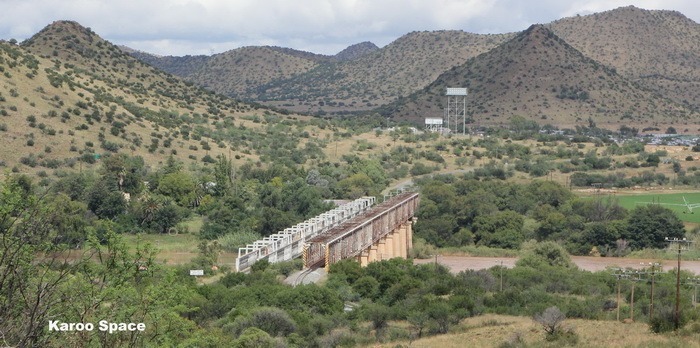
Many years ago, Paul and Suzette Johns bought land on the Orange River near Norvalspont. Part of their acquisition was an old British blockhouse, a sturdy fort made of stone and steel. Its twin had once stood on the other side of the river. Both had shooting slits and housed soldiers who guarded the bridge against the Boers. Not well enough, as it turned out. The twin fort on the other side of the river was dismantled by a farmer decades ago, its stones used to build a piggery.

Suzette’s father (she was from Venterstad) encouraged Paul to fix up the old blockhouse, then falling apart. Paul did more than that. He saw it commanded a glorious view of the river and decided it would be a splendid place to live.
And so the sturdy old blockhouse was to be transformed into a modern home. His first job was to clear out the snakes and rats, then make a doorway at the bottom. The British soldiers had used a ladder that led to a narrow entrance several metres up.
Turning a mini-fort into a modern-day dwelling was a work of love, construction genius and very crafty interior plumbing. The kitchen and living areas were at the bottom, with a fireplace that heated up the three storeys above it. He and Suzette thrived there for 45 years and raised four children in it. It was snug and colourful as a gypsy caravan. But for Paul, the best thing was the view over the river, which he adored.
It was your typical Huckleberry Finn or Wind in the Willows kind of life for the Joneses. The kids swam in the river and caught barbel (catfish) and often slept outdoors. They moved into a regular house nearby only when Suzette had a hip replacement and could not climb the blockhouse steps for a while. But now it was time to go.

“One of our sons has been nagging us to come and live with him on his farm outside Bloemfontein,” says Paul. “We’ve decided to move there now because I am over 80 years old and tired of farming. But I told him we would have gone sooner if he could divert the river there. I’ve loved so much about living here, the blockhouse, the farming, the veld. But it’s the Orange River that I’ll really miss.”
And just like that, another light goes out at Norval’s Pont. But the legends will shine on forever.
For an insider’s view on life in the South African Heartland, get the Karoo Quartet set of books (Karoo Roads I-IV with black and white photographs) for only R960, including taxes and courier costs in South Africa. For more details, contact Julie at julie@karoospace.co.za


