

Text and Photographs by Chris Marais and Julienne du Toit
The mission of the May 2026 Mad Bird Journey from Cradock, Eastern Cape, down to Route 62 in the Western Cape, was to introduce the region to our new book, Klein Karoo Magic.
Why ‘Mad Bird’? Take a quick look at the cover.
The first days of May brought early rains to our stomping grounds, the Karoo Heartland, and it was a thrill to see Graaff-Reinet’s Nqweba Dam overflowing like gangbusters. We’ve been there in past years, when it resembled a giant cracked dustbowl. Up here, we never say no to rain. Well, almost never.
Heading south, we passed the uncharacteristically full Beervlei Dam, which controls the floodwaters of the Sout River, which then becomes the Groot River.
First stop was supposed to be at Toorwater Poort, but the raging Traka River had isolated our friends in their cottage at the little railway siding near the canyon, so we continued to Uniondale.
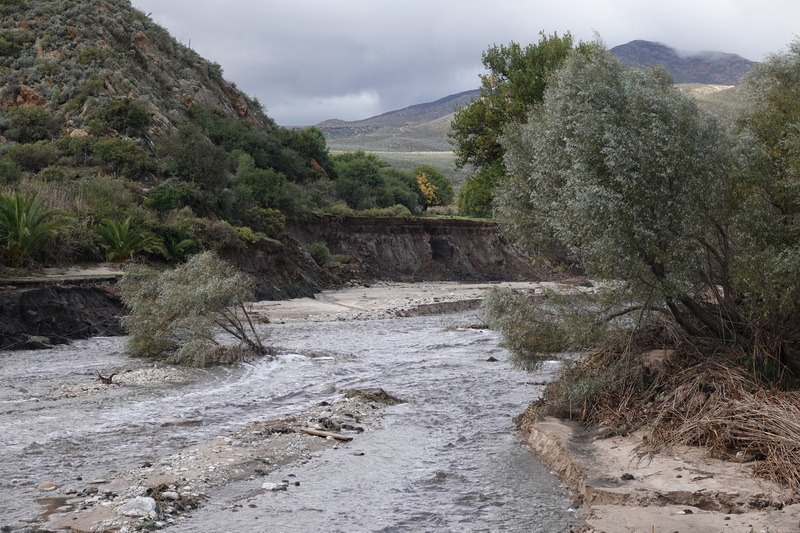
The northern entrance to the little town was closed, because the Kammanassie River had swept away the bridge. We took the second entrance into Uniondale, to discover everyone busy repairing storm damage to their shops and homes. We suddenly realised the seriousness of the May 4 deluge that had befallen the Klein Karoo. More than 300mm of rain in less than three days, we heard.
The Headless Ghost
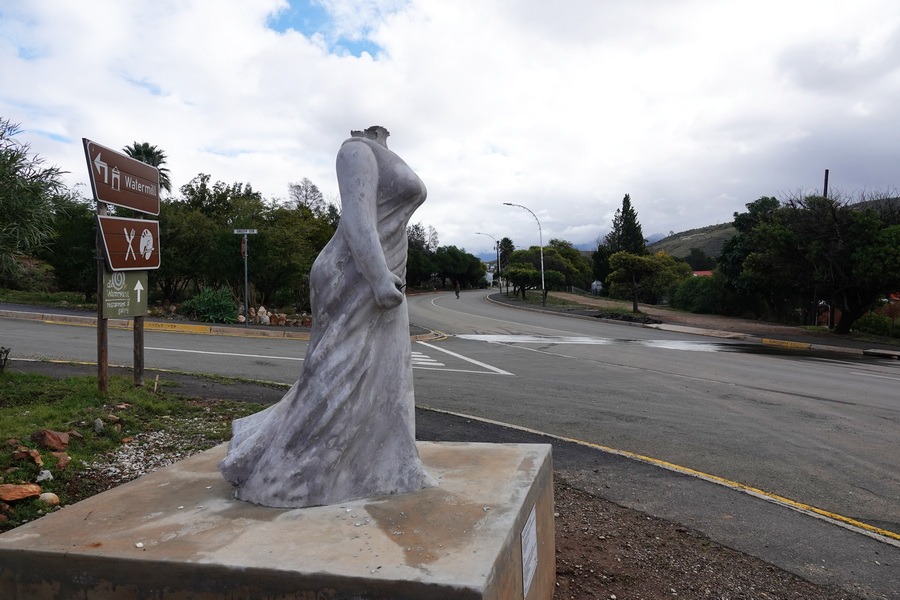
“Go look at the Ghost Lady statue,” someone said. “She’s lost her head, and there’s a reward out for it.”
We dutifully went off to find her and yes, either the storm or human had decapitated her.
“She’s probably lurking on someone’s bar counter at home,” a local said. Not everyone in Uniondale is crazy about the ghost-branding of their town.
Standing at the broken bridge and marvelling at the immense power of the waters, a couple in a Suzuki Jimny who hail from the nearby community of Noll told us they’d measured an incredible 400mm of rain in 48 hours at their home.
“I wrote a poem about it,” said the driver.
Dalene Matthee Festival
Our overnight destination was the tiny hamlet of Herold, on the cusp of the Langkloof and the Klein Karoo, to prepare for Klein Karoo Magic slideshow at the Dalene Matthee Book Festival the next morning. Herold nudges up against the Montagu Pass, which has been closed for repairs for ages.
The N9 highway had only just been opened for traffic. We drove through a land glutted with water. Streams were pouring out of the mountains, a shiny tracery of water spilling across farms and fields, paddocks turned into lakes, water flowing across the road in places. There were shallow lakes were once were fields, rivulets flowing over the roads.
Arriving in Herold, we were met by the master of litfests, Darryl David, who gave us the news: no electricity, no water. Our slideshow suddenly morphed into a book talk. No worries.
Our hosts were Theo and Bernice Adams, who own the farm that is part of the village. Here they cultivate proteas, farm with sheep and process the locally-famous honeybush varietals (known as Kaukou) into tea and cosmetic creams.

A Word from the Chief
One of the other speakers we met was the chief of the Attaqua people, Poem Mooney. He spoke of the mountains and rivers that carry the last remaining words of the Attaqua nation, like:
Tradouw Pass, the Outeniquas Mountains, the Kammanassie River, the Kingna and the Keisie Rivers.
He was an inspired by the floods.
“Water has a memory,” he said. “And I am seeing how tiny little streams grow and join and become greater. How the Kammanassie meets the Olifants at a place called Shadowlands. The Olifants is fed by the Traka and the Sand Rivers.
“At the confluences, there are water maidens.
“We too can come together like the streams and canals. We can flow together and make a difference. Look how powerful this water is!”
No kidding.
Storm Round-up
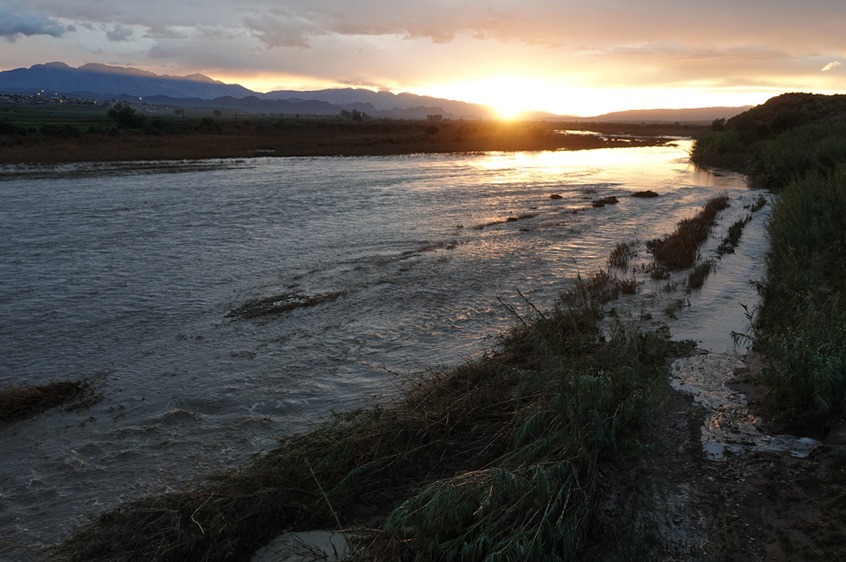
Entering Oudtshoorn after our talk in Herold, we had to cross the swollen Olifants River, which had been fed by the Traka and the Kalkwal rivers, as they roared over the Stompdrif Dam at Domein Doornkraal Farm outside De Rust.
In Oudtshoorn for a week, we heard stories of farmers who had lost 3 000 Angora goats to the cold and rain, dozens of ostriches that had been swept downstream and drowned, cattle that had been stuck in the mud and broken their bones. They had to be put down where they stood.
The entire Langkloof, we heard, was still without power. The strong winds that felled trees had also torn down power pylons. It would take weeks to replace them. The Gamtoos valley had been particularly hard hit – entire orchards were scoured away by the storm. Pumpkins were bobbing in the ocean from St Francis to Nelson Mandela Bay. We saw footage of the dreadful winds that peeled the roofs off malls and blocks of flats in George.
Access to South Africa’s first-ever tourist destination, the Cango Caves, was blocked by an immense rockfall. The floods also hit the Cango Wildlife Ranch, leading to a massive emergency animal evacuation operation. They were closed but later admitted visitors on a paying tour of the clean-up efforts.
Down the road and deep into the Swartberg Mountains, Gamkaskloof (Die Hel) was cut off from the world. The tricky Elands Pass leading down to the settlement had been badly damaged, and a successful Back-a-Buddy campaign was on the go, to repair the road.

Smousing in the Storm
We were opening new stores in the district with Klein Karoo Magic, and re-stocking our existing outlets. One day, we drove across to De Rust to spend time with some very depressed villagers. De Rust, the eastern gateway to the Klein Karoo, has traditionally been blessed with its busy through-traffic. Now, however, the Groot River had burst into Meiring’s Poort from the north and the road connecting De Rust to Klaarstroom, Prince Albert and Beaufort West was gutted. To top it all off, the Swartberg Pass was also closed, due to landslides. So too Seweweeks Poort. And the Gamkapoort Dam topped 135%.
Westwards we went, always three days in the wake of the worst environmental disaster to hit the Western Cape in living memory. Down the R62, however, the storm damage was less severe. We dropped off books in Kruisrivier, Calitzdorp, Zoar and Barrydale, where we slept over for one night.
The next day, we drove into a buzzy Montagu, staged a slideshow at the Country Hotel and spent the weekend with friends who own a wine-and-olive farm in town. They took us through the Cogmanskloof to the Ashton-Robertson area, where the flooding Breede River had caused enough damage to remove and buckle a massive red iron bridge that had stood for 120 years.
The storm monster had moved through here and swerved northwards, to continue its devastation in the Cederberg.
The Return Trip
Finally, after nearly three weeks of trading and travelling, we turned around and pointed the Karoo Space bakkie in the direction of home. Our stock was completely depleted, and we had opened no fewer than 26 new outlets. It had been a good run for us.
To add to the joyous vibe in the bakkie, the return journey was nothing short of inspiring.
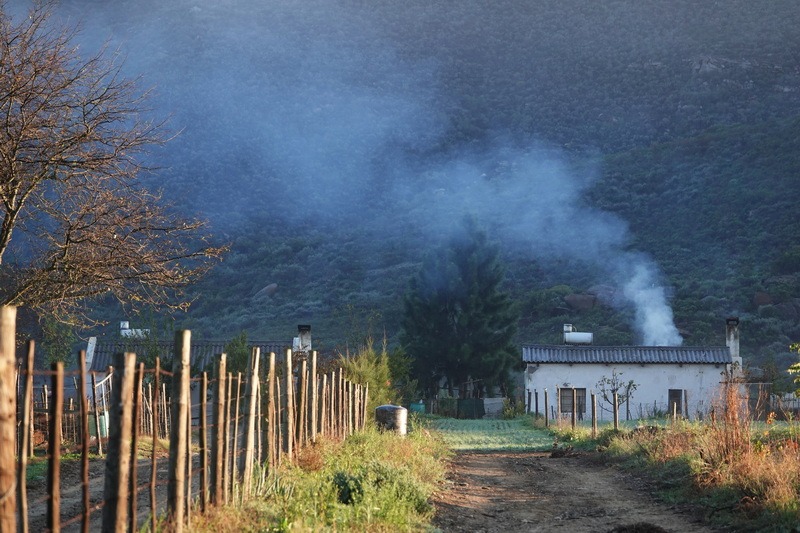
Western Cape disaster teams were everywhere, beginning the long and arduous fix-up of the province. The new rains had turned last year’s khaki, water-starved veld into Irish green, the mountains were glowing in the sun and the rivers were flowing at an innocent, gentle pace.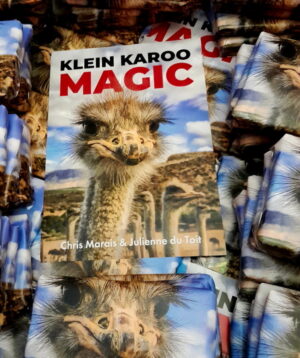
Even the people of the Klein Karoo were mostly on the mend. Our last stop was at the elegant MooiKaroo gift shop in De Rust, and a chat with the owner, Freda Schoeman.
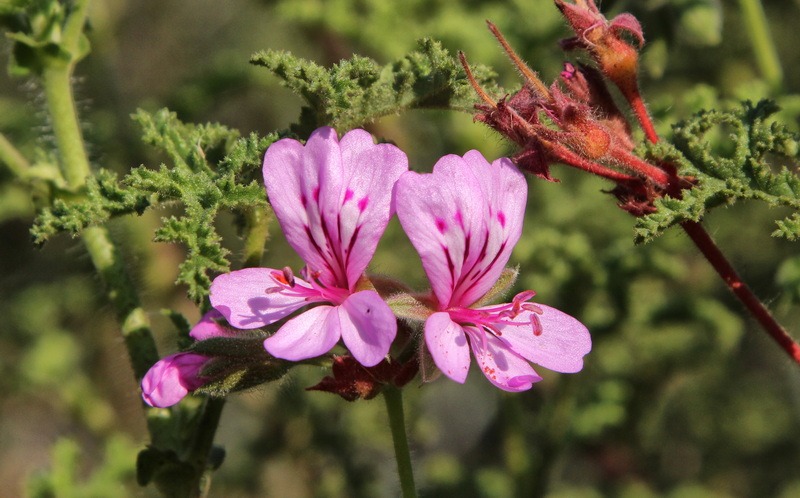
De Rust is re-imagining itself, this time as a full-on destination. Freda and a gang of De Rusters are planning to use the beautiful pelargonium (‘malva’ in Afrikaans), which thrives in the area and has traditionally graced many a window box in Europe, as the village icon.
There will be a Mad About Malvas festival (Mal’va De Rust) soon, and the village will wait patiently for the poort access to be rebuilt. In the meantime, all the little shops, bars and guest houses are open for travellers going in and out of the Klein Karoo.
There is a human resilience in this region that matches the moods of the mountains that surround it.
Note: The wet season was not finished with the Klein Karoo, however. Three weeks later, the rains returned and the rivers were swollen once more. Travellers were advised to check route updates and, if possible, support rescue and clean-up efforts throughout the region. Social media is currently full of heartbreaking stories on storm damage in a number of places, like Meiring’s Poort, Gamkaskloof and the Cango area. Everyone there needs your help.
- To order your copy of Klein Karoo Magic (R400, including courier within South Africa and taxes), contact Julienne du Toit at julie@karoospace.co.za


