By Julienne du Toit
We had a friend in Beaufort West who once compiled a great Karoo cookbook. It was a perfect symphony of interesting food and immersive storytelling. But her life and achievements went way beyond the book.
We last saw her more than a decade ago and were trying to get an update on her recently. Sadly, she passed away in 2024, and we missed our chance to see her again. Nevertheless, her story, which we captured after her book launch, will live on in the annals of Karoo heroes. And here it is, fresh and relevant as ever.
The Essop Family
Everyone from Beaufort West in the Central Karoo knows the Essop family.
Sydda Essop, daughter of Amina and Solly, wrote a remarkable book, Karoo Kitchen, first published in 2012.

Her father used to be the famous one in the Essop family. He was a retailer, the maker of the locally famous cooldrink Sonsap, and a fiercely committed anti-Apartheid activist from the 1940s through to his death in 1984.
The Essops’ house on the outskirts of Beaufort West hosted many well-known politicians.
“Nelson Mandela often held me on his lap when I was a baby,” Sydda told us with a shy smile.
Chris and I visited her at her mother’s house in Beaufort West in 2012, for a profile that would be published in Country Life magazine.
Solly Se Kind
Sydda told us she would travel with her father when he was going around the countryside campaigning for farmworkers’ rights.
“People knew me as ‘Solly se kind’ (Solly’s child). That’s when I became interested in how people lived, and what they ate.”
Sydda studied art at the Michaelis School of Fine Art at the University of Cape Town. She then became involved in helping women and children, especially those whose husbands had been arrested after taking part in protest marches.
Later she would start The Karoo Gender Forum in the Central Karoo to empower young women and girls. And Sydda also became a published poet.
Her fascination for people continued when she later worked in the supermarket she co-owned with her sister.
“I wondered how people ate on an R800 grant, as it was then. I’d see people buying chicken on a Sunday. They’d buy cabbage, beetroots, carrots, fat pieces and tins of fish. I wanted to know: how did they prepare it?
“When I drove past a farmhouse, I’d wonder what they were having for lunch.”
The Root Cuisine
These questions led to her to do something very few people would have done. In 2007 Sydda sold her house in Cape Town and set off in her Nissan Navara to find out what the people of the Karoo eat.
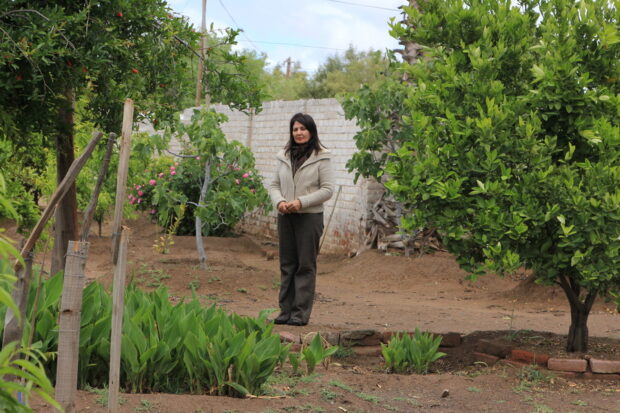
“Karoo food is one of the root cuisines of South Africa,” explained Sydda. Now with increased in-migration of former urbanites, the region is becoming more conscious of its foodie credentials.
The Karoo’s cuisine is being spiced up by new arrivals – Somalis, Bangladeshis, Pakistanis. Many have already left their mark on it: Malay, Trekboer, Xhosa, slaves, bywoners and free men.
Stored for Posterity
Two things convinced Sydda she’d made the right decision. Firstly, she’d sought out the help of her mentor, Cecyl Esau of the Institute for Justice and Reconciliation, a former head of Umkhonto we Sizwe.
“He met me for coffee, and he just listened to my ideas. At our next meeting, he gave me a digital recorder and told me: ‘This is going to be a social document, and these stories need to be told for posterity’.”
Secondly, Sydda felt encouraged after meeting Craig Fraser and Libby Doyle of Quivertree Publications. They had also published another award-winning Karoo cookbook, Prickly Pears and Pomegranates by Bernadette le Roux and Marianne Palmer of Cranemere Farm near Pearston.
“I needed publishers who understood this was a collective piece of work. I often tell the children and battered women I work with, that you need to believe and to dream. But what I’ve also realised is that you need someone to believe in YOU. And that is what I got with Craig and Libby, and editors Johan van Zyl and Lin Murray. I cannot speak highly enough of them.”
Sydda moved back home with her mother Amina, using Beaufort West as a base.
All of South Africa
She talked to boeretannies and recorded their thoughts about food and life and their recipes. She spoke to people with Dutch surnames, French Huguenot surnames, English surnames, Greek, Portuguese, Xhosa and Malay.
She spoke to farmers wives and farmworkers. Some of them made her lovely teatime spreads of scones and clotted cream with homemade jam. Others asked if she would mind drinking tea from their own cups, since there were no others.

One of her most vivid memories was interviewing a Somali woman, who lived in what was then the poorest and most violent settlement in Beaufort West, a place they called Baghdad.
“What the Somalis and the Congolese have taught us is how to do informal business. They come with absolutely nothing. This Somali woman I interviewed had nothing. But the other day I met her to give her this book, and she was doing so much better. She and her family are still living in their store, but it is much better, in a different area and bigger. Her children are speaking fluent English and Afrikaans and playing tennis.”
An Interesting Food Heritage
In her book, Sydda featured people from Loxton, Victoria West, Murraysburg, Prince Albert, Britstown, Hopetown, Nelspoort and of course, Beaufort West.
On the front cover of Karoo Kitchen, it says: “Heritage recipes and true stories from the heart of South Africa”.
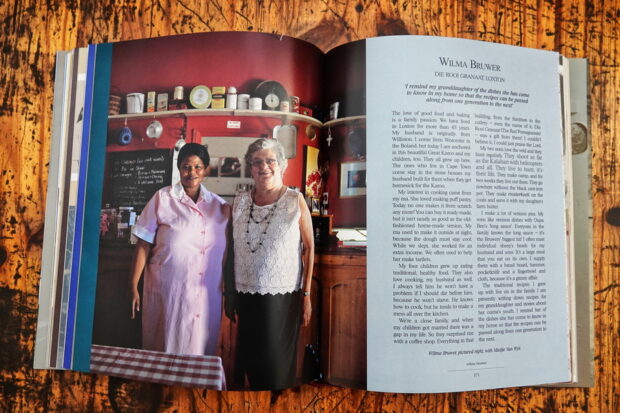
These words neatly encapsulate the book. Here you will not just learn how to cook venison, but specifically the stuffed springbok loin that Amanda Loots of Victoria West likes to make.
In its pages, you’ll encounter Debbie Anstey’s chicken soup and kneidlach, Benita Johnson’s marinated grilled mutton rib and Sophie Louw’s method of making kaiings (mutton crackling).
It has tradition along with innovative meals, like the late Bokkie Botha’s starter with figs and ham, or his famous spicy bread sticks, devised with one of the upcoming chefs he mentored, Henry Olivier.

Famous tracker Pokkie Benade gave his family recipe for kambro jam, and revealed his favourite edible and medicinal Karoo plants: dassiesbos, rooivergeet, willekeur and ystertong.
The book contains Bettie Japhta’s midwife recipes to help babies with jaundice, babies born with a caul, babies with wind, and mothers who don’t have milk.
Amina Essop, Sydda’s mother, offered her recipes for lamb curry and refreshing pomegranate juice, alongside reminiscences of how she came to the Karoo from India to marry Solly.
A Gift to the Karoo
That is the charm of this book. Alongside people’s personal recipes, they give you an insight into their lives.
There are meals of luxury, like rolled shoulder of venison and naartjie ice cream, and meals of economy and opportunism, like sheep’s head baked in a sheep’s stomach, and leg of caracal.
Porcupine crackling is apparently delicious, and this book is where you’ll find out how to prepare it.
It is Dillys Trollip of Britstown (the source of a wonderful lamb sosatie recipe) who puts her finger on a big part of the appeal of Karoo and food:
“In the Karoo, hospitality is very important, probably because we live so far apart. When we call on each other, things are done properly.”
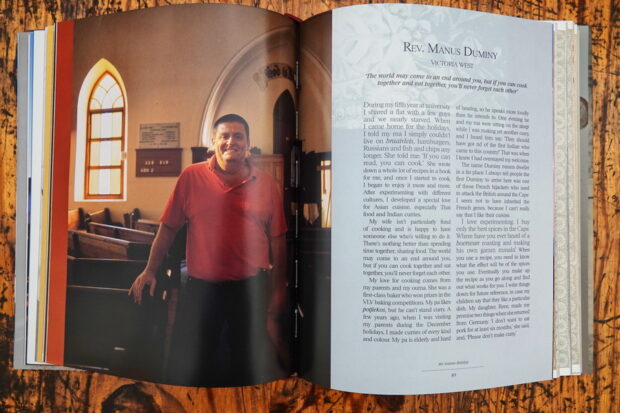
For Sydda, this book was an act of love.
“People absorb flavours and ideas from one another, right across class and race barriers. Food is what binds us together. As I travelled and spoke to so many people – far more than are reflected in the book – I learnt humility, because I could see we have all suffered from the past. I could also see we are united by similar values.
“This book is a tribute to the people that I interviewed. This is my gift to the Karoo.”
- Sydda Essop died in February 2024, after a long battle with cancer. Her book, Karoo Kitchen, is a true piece of Africana and is now out of print. The Afrikaans edition is called Karoo Kombuis.